Your Guide to Certified Penetration Testing
Understand penetration testing credentials and organisational accreditations, how to evaluate tester capability, define scope, review evidence and plan retesting.

Understanding the Real Value of a Certified Test

Imagine your company's digital security is a newly built bank vault. You could ask the construction firm to check its own work, or you could hire a certified, independent inspector to try and break in. That second option is the only one that gives you genuine confidence in the vault's strength.
This is the core idea behind certified penetration testing. It's not just another scan or check-up; it's a rigorous, ethical, and standards-based evaluation of your defences, performed by a trusted expert.
The word 'certified' isn't just marketing fluff. It means the individuals and the company running the test have met stringent professional and technical standards. This gives you peace of mind that the simulated attack is both thorough and conducted by people who follow a strict code of conduct.
Beyond the Automated Scan
A standard vulnerability scan is like a security guard walking around a building and checking if the doors are locked. It's a useful baseline, but it's limited.
A certified penetration test, on the other hand, is like hiring a team of experts to actively try and bypass those locks, find an unlocked window on the second floor, and discover any other clever ways an intruder could get inside.
This human-led approach brings a few critical advantages to the table:
- Contextual Analysis: Certified testers think like real attackers. They can chain together multiple low-risk vulnerabilities to create a high-impact exploit path—something automated tools almost always miss.
- Business Logic Flaws: They can spot weaknesses in your application’s logic, like a flaw in a checkout process that lets someone manipulate prices. These are completely invisible to scanners.
- Reduced False Positives: Expert analysis cuts through the noise. This allows your team to focus on fixing genuine, exploitable security gaps instead of chasing ghosts.
A certified test gives you an honest, actionable assessment of your security posture, not just a tick in a box. It’s a vital step for any organisation that wants to understand its true risk exposure.
This proactive approach to security is becoming non-negotiable. As you scale, being able to prove your security measures are robust is essential for building trust with customers, partners, and even insurers.
In fact, many providers now factor in the role of penetration testing in cyber insurance underwriting, making a certified report an incredibly valuable asset. Ultimately, choosing a certified provider means you're investing in a proven methodology to genuinely strengthen your defences against real-world threats.
Navigating Key Penetration Testing Methodologies
A proper certified penetration test isn't just a chaotic free-for-all; it's a structured campaign guided by a proven roadmap. Think of these methodologies as different blueprints for checking a building's security. You wouldn't use the same plan for a skyscraper as you would for a small house, and the same logic applies to cybersecurity.
These frameworks give testers a systematic, repeatable process. This ensures the assessment is thorough and the results are reliable. Without a clear methodology, a test becomes unpredictable, potentially missing critical flaws and delivering wildly inconsistent outcomes. Certified pros lean on these standards to guarantee comprehensive coverage, every single time.
The Specialist Toolkit: OWASP
When your main worry is the security of your web applications or APIs, the Open Web Application Security Project (OWASP) framework is the undisputed standard. It’s like a specialist's diagnostic toolkit, purpose-built to find the kinds of flaws unique to web-based technologies.
OWASP's most famous resource is its "Top 10," a regularly updated list of the most critical security risks facing web applications today. A certified test following this methodology will rigorously hunt for issues like:
- Injection Flaws: Where an attacker tricks an application into running malicious commands by sending it hostile data.
- Broken Authentication: Weak spots in how users are identified and managed, opening the door for account takeovers.
- Security Misconfigurations: Simple but common mistakes, like leaving default passwords active or showing overly detailed error messages that leak information.
By zeroing in on these known, high-risk areas, an OWASP-aligned test delivers a deep, relevant analysis of your most public-facing assets.
The Master Blueprint: PTES
If OWASP is the specialist, then the Penetration Testing Execution Standard (PTES) is the master blueprint for a full-scale engagement. It lays out the entire lifecycle of a comprehensive penetration test, covering everything from the first planning session to the final report. This makes it a fantastic fit for complex network and infrastructure assessments.
PTES breaks the entire process down into seven distinct phases. This creates a logical flow that ensures no stone is left unturned, providing the kind of clarity and consistency that is vital for a certified engagement.
The whole idea behind PTES is to standardise the "what" and "how" of a penetration test. It establishes a baseline for what a quality assessment should actually look like, moving testing from a creative art form to a defined, professional discipline.
The infographic below shows how these structured, certified approaches lead to tangible benefits.
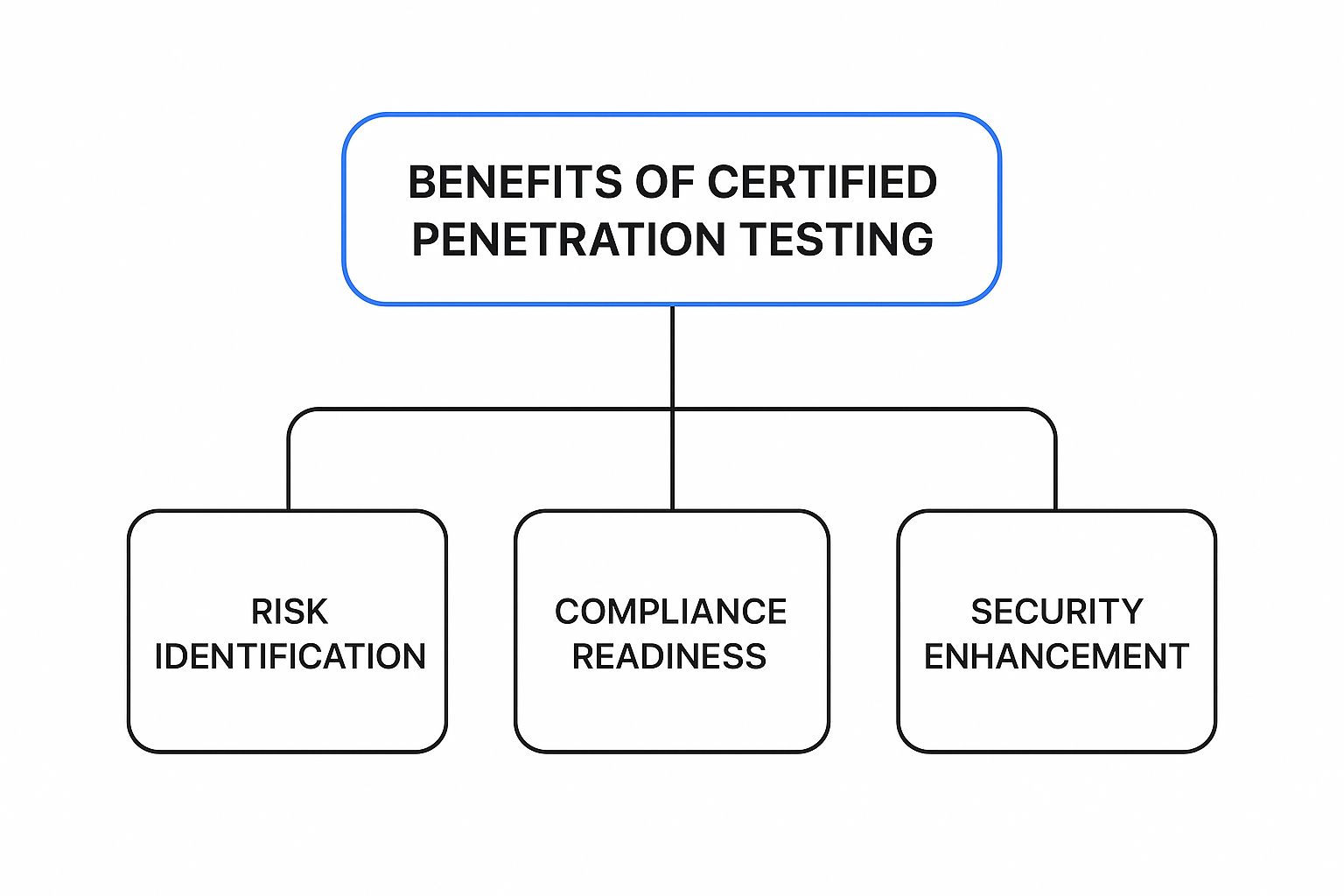
This hierarchy makes it clear: structured testing leads directly to better risk identification, compliance readiness, and a stronger security posture overall.
The Enterprise Standard: NIST
For larger organisations, particularly those in regulated industries or working with government bodies, the National Institute of Standards and Technology (NIST) provides the enterprise-grade framework. NIST's Special Publication 800-115 is the go-to technical guide for information security testing and assessment.
This methodology is less of a step-by-step guide and more of a strategic framework. It helps organisations weave security testing into their broader risk management programmes, ensuring everything aligns with business goals.
Ultimately, picking the right methodology comes down to your specific goals and assets. But a modern approach often involves combining these frameworks with more flexible delivery models. To see how this works in practice, check out our comparison of penetration testing vs Penetration Testing as a Service (PTaaS).
The Role of Certification Bodies and Standards
When you hire a certified penetration tester, you’re not just buying a service; you’re investing in a professional who’s been held to an incredibly high standard. But who actually sets these standards? That’s where certification bodies come in.
Think of them as the gatekeepers of the ethical hacking world. They’re the ones making sure that both individuals and entire companies have elite technical skills and unwavering professional integrity.
These organisations do far more than just hand out certificates. They create and enforce strict codes of conduct, establish proven methodologies, and validate a tester's skills through demanding, practical exams. It’s this framework that separates a genuine certified penetration testing engagement from just another unverified security audit.
Put simply, choosing a provider aligned with a respected body gives you confidence. You know the people testing your systems can simulate sophisticated cyberattacks and can be trusted with your most sensitive data.
Key UK and Global Certification Bodies
In the UK, a few key organisations are widely recognised for setting the benchmark for quality and professionalism in security testing. Knowing who they are helps you quickly verify the credentials of any potential testing partner.
These include:
- CREST (Council of Registered Ethical Security Testers): A globally respected body that accredits both companies and individual testers. A CREST certification means they’ve met tough technical and ethical standards.
- TigerScheme: This is a UK-focused commercial certification scheme. It offers a clear career path for testers, with qualifications that are recognised by major public and private sector organisations.
- CHECK: Run by the National Cyber Security Centre (NCSC), CHECK accreditation is non-negotiable for providers conducting penetration tests on UK government systems and critical national infrastructure.
Beyond these UK-specific schemes, some global credentials are exceptionally prized. The Offensive Security Certified Professional (OSCP) is a big one. It's famous for its gruelling 24-hour, hands-on exam where candidates have to compromise multiple systems in a live lab environment. It's the ultimate proof of practical, real-world hacking skills.
Certification is the industry’s answer to a critical question: "How do we know we can trust you?" These bodies provide a verifiable, standards-based response, ensuring a baseline of quality, ethics, and technical skill.
The growing focus on these standards makes sense when you look at the numbers. The UK's cybersecurity market is projected to hit around £14 billion by 2025, driven by a surging need for robust security validation.
Whether services are delivered through manual, automated, or hybrid testing, they all require skilled professionals to be effective. As you can find out from more insights about the UK's evolving penetration testing market on beaglesecurity.com, these bodies ensure that as the market grows, so does the calibre of the professionals within it.
How Penetration Testing Achieves Compliance
For many organisations, penetration testing isn't just a proactive security measure—it's a non-negotiable part of regulatory compliance. Think of a compliance framework like a building inspector's checklist. A certified penetration test is the practical, real-world proof you need to show you’ve met the inspector’s toughest security standards.
Without it, you’re essentially just claiming your systems are secure. But with a certified test report in hand, you have independent, verifiable proof that your defences have been scrutinised by an expert actively trying to break them. This completely changes the conversation with auditors, moving it from "we believe we're secure" to "here is the evidence that our security controls work as intended."
This kind of evidence is indispensable for meeting legal, regulatory, and industry rules. It demonstrates due diligence and shows you’re taking tangible steps to protect sensitive data, which is the whole point behind most compliance mandates.
Linking Testing to Key UK Compliance Frameworks
Different regulations have their own specific demands, but the need for security validation is the common thread tying them all together. A certified penetration test directly addresses these mandates, providing the necessary documentation for auditors and stakeholders.
Here’s how it lines up with major frameworks:
- PCI-DSS (Payment Card Industry Data Security Standard): This is mandatory for any business that handles cardholder data. Requirement 11.3 explicitly calls for regular internal and external penetration testing to find and fix vulnerabilities in the cardholder data environment.
- SOC 2 (Service Organisation Control 2): To get SOC 2 compliant, organisations must prove they can protect client data. Penetration testing provides crucial evidence for the "Security" Trust Services Criterion, showing how effective your controls are against simulated attacks.
- HIPAA (Health Insurance Portability and Accountability Act): While HIPAA doesn't explicitly mandate penetration testing, its Security Rule requires organisations to conduct a "risk analysis" and implement measures to protect electronic patient health information. A certified test is widely accepted as a best practice for fulfilling this.
This proactive approach is vital in today's threat environment. The UK's Cyber Security Breaches Survey 2025 found that cyber attacks are a persistent problem, hitting 67% of medium-sized businesses and 74% of large ones. In that context, penetration testing is recognised as a crucial strategic defence, not just another box to tick. You can find out more in the latest government survey on gov.uk.
From Vulnerability to Audit-Ready Report
The final report from a certified penetration test is much more than a list of flaws; it’s a powerful compliance asset. These reports are structured to give clear, actionable insights that auditors can easily understand and check.
A certified penetration testing report serves a dual purpose. It acts as a remediation roadmap for your technical teams and as a certificate of due diligence for your compliance stakeholders.
This documentation is also crucial for frameworks like ISO 27001, which requires organisations to manage information security risks in a systematic way. The insights from a test feed directly into this risk management process. To understand this relationship better, check out our guide on ISO 27001 penetration testing and its role in UK compliance.
Ultimately, a certified test transforms a theoretical security policy into a proven, battle-tested reality.
How to Choose the Right Testing Provider
Picking a partner for a certified penetration test goes way beyond just comparing quotes. The right provider becomes an extension of your security team, giving you genuine insights that actually strengthen your defences. The wrong one? They’ll hand over a shallow, automated report that just ticks a box but leaves you completely exposed.
To make a smart decision, you need to look past the sales pitch and start asking the right questions.
It’s all about the people, not just the company name on the invoice. A provider might flash corporate accreditations, but it’s the skill of the individual testers assigned to your project that truly matters. You need to be sure you’re getting hands-on expertise from people who live and breathe this stuff.
Vetting Your Potential Security Partner
When you're evaluating providers, don't be afraid to get into the weeds. Their answers will tell you everything you need to know about the depth of their process and whether they’re committed to being a real security partner.
A great place to start is by asking for specifics about the team who will be doing the work. You should feel confident asking direct questions to understand exactly who will be testing your systems.
-
Ask About Individual Certifications: Get specific about the qualifications of the testers on your engagement. Are they CREST registered? Do they hold an OSCP certification? This simple question confirms you’re getting proven experts, not just juniors running a scanner.
-
Request an Anonymised Sample Report: The report is the main thing you're paying for. Looking at a sample shows you how clearly they communicate findings, whether they provide actionable guidance for your team, and if they can separate critical risks from low-level noise.
-
Gauge Their Post-Test Support: What happens after the report lands in your inbox? A quality partner will offer to walk your team through the vulnerabilities and will be available for retesting once you’ve rolled out fixes. This follow-through is non-negotiable.
A truly valuable penetration testing provider delivers more than just a list of vulnerabilities. They provide a clear, prioritised roadmap for remediation and act as a resource to help your team effectively reduce risk.
Understanding the Scope and Methodology
Beyond the team's credentials, the provider's actual approach to the test is critical. A one-size-fits-all methodology rarely uncovers the unique business logic flaws that can cause the most damage. You need to ensure their process aligns with your specific technology and security goals.
This means discussing the scope in detail so they understand what’s most important to your business. A good provider will tailor their approach, blending automated scanning with deep manual analysis to uncover complex, chained exploits that tools alone would miss.
Finally, clarity on process and cost is essential. Look for transparent models that fit how your team works, whether it’s a one-off assessment or a recurring testing programme. Speak to Pentestly with an asset and role inventory to receive a scope built around actual testing effort.
Making an informed choice here ensures you invest in a partnership that genuinely improves your security posture.
Answering Your Top Questions About Certified Penetration Testing
Even with the technical details covered, you probably still have some practical questions. That’s normal. Getting into the weeds of methodologies is one thing; figuring out what it all means for your business is another.
Let's tackle the questions we hear most often. Think of this as the straight-talking FAQ section to clear up any final uncertainties before you pick up the phone.
Quick Answers to Common Questions
Before we dive deeper, here's a quick summary table for the most common questions we get asked about penetration testing.
| Question | Brief Answer |
|---|---|
| How often should we get a pen test? | It depends on your development speed. Annual tests are outdated. Test after major changes and consider monthly or quarterly cycles if you ship code often. |
| What's the difference between a pen test and a vulnerability scan? | A scan is an automated tool checking for known flaws (like a security guard checking for unlocked doors). A pen test is a human-led simulated attack that tries to break in, finding complex issues tools miss. |
| Why can't we just run a scanner? | Scans find the low-hanging fruit. They can't find business logic flaws, chain multiple small issues into a major breach, or think creatively like a real attacker. |
| How long does a pen test take? | This varies based on scope, but a typical web application test can take one to two weeks. More complex systems or networks will take longer. |
| What do we get at the end? | You'll receive a detailed report outlining all vulnerabilities found, ranked by risk, with clear, step-by-step instructions on how to fix them. |
Now, let's explore a couple of these in more detail.
How Often Should We Conduct a Penetration Test?
This is easily the most frequent question, and the old-school answer of "once a year" is dangerously out of date. While an annual test might tick a compliance box, it’s a snapshot in time. For a modern UK business, a single test just can't keep up with the pace of change.
The reality is, your systems are constantly evolving. New code gets pushed, infrastructure is updated, and fresh attack techniques emerge daily. A better approach is to match your testing frequency to your operational tempo and risk profile.
- After Major System Changes: Did you just launch a big new feature? Migrate to a new cloud provider? Overhaul a core piece of your infrastructure? You need to test it. Immediately.
- For Compliance Mandates: Some frameworks, like PCI-DSS, require at least an annual test. But that's the bare minimum. Your risk level might demand more frequent checks to stay truly compliant.
- If You're Shipping Code Constantly: For teams working in a CI/CD environment, security testing needs to be part of the development loop, not an annual afterthought. Catching flaws early is always cheaper and safer.
The traditional annual penetration test is becoming obsolete. A proactive security posture demands a more agile, continuous approach to validation that actually matches the speed of your business.
This shift isn't just theoretical; it's a practical move that's gaining huge traction. Monthly or continuous penetration testing is now a core strategy for UK organisations looking for smarter, more cost-effective security. The data backs this up, showing this approach can slash the time it takes to find vulnerabilities by up to 80% and uncover them six times faster than a single yearly test. You can dig into more of the numbers on the benefits of monthly vs. annual testing on e-zu.co.uk.
What Is the Difference Between a Pen Test and a Vulnerability Scan?
This is a critical distinction, and one that trips up a lot of people. Using these terms interchangeably is a common mistake that can lead to a false—and very dangerous—sense of security.
A vulnerability scan is completely automated. It’s a piece of software that runs against your systems, checking for a list of known issues like outdated software, missing patches, or common configuration mistakes. Think of it like a security guard walking the perimeter of a building at night, checking that all the doors and windows are locked. It’s fast, and it’s a good baseline hygiene check.
But a certified penetration test is a human-led, goal-driven exercise. A certified ethical hacker is simulating a real-world attack. They're not just checking the locks; they’re actively trying to pick them. They're looking for an open window on the second floor, trying to tailgate an employee through the front door, or figuring out how to bypass the alarm system.
This manual, creative approach uncovers the complex, multi-step attack chains that automated tools will always miss. It's the difference between knowing your doors are locked and knowing if your building is actually secure.
Ready to move beyond basic scans? Pentestly's in-house testers use bespoke AI agents to broaden exploration, then reproduce and evidence every reported issue. Speak to the team about your scope.
Get started
Need professional security testing?
Speak directly with our team about the risks, scope and testing approach that matter to your organisation.
More Articles
Internal Penetration Testing: Scope and Methods
Plan an internal penetration test around identity, segmentation and critical assets, with practical guidance on scope, access, evidence, reporting and retesting.
Supabase Security: Lessons from Real Pentests
Harden Supabase with the following cheat-sheet with clear steps for RLS, schemas, Edge Functions, Storage, CORS and tokens. Built from real audits.